
Protecting Your Child’s Smile After Early Tooth Loss
Baby teeth do a lot more than just fill a smile. They hold space in the jaw for the permanent teeth that will follow, guide those teeth as they come in, and support normal jaw development. When a baby tooth is lost too early, whether from decay, injury, or tooth extraction, that space can close before the permanent tooth has a chance to arrive. Space maintainers are a simple, effective way to keep that from happening.
At Dental Care Group Kids, our pediatric dental team regularly fits children with space maintainers in our Aventura and Pembroke Pines dental offices. Families from Hallandale Beach, Hollywood, Sunny Isles Beach, and across South Florida trust us to guide their children’s dental development with care and attention. If your child has lost a tooth before it was ready, call our Aventura office at (305) 935-1613 or our Pembroke Pines office at (954) 430-2300 to find out if a space maintainer is the right next step.
From Space Maintainer to Healthy Permanent Smile: Ongoing Support at Your Full-Service Dental Clinic
One thing that sets Dental Care Group Kids apart is the continuity of care we provide. We do not just place a space maintainer and send your family on their way. Our pediatric dental team and orthodontist monitor your child’s progress at every follow-up visit, checking the appliance, tracking the development of the incoming permanent tooth, and removing the maintainer at exactly the right time.
If we notice any concerns with how the permanent tooth is erupting, we address them early before they develop into anything more complex. Our relationship with your child does not end at placement. It continues through every stage of their dental development.
 What Is a Space Maintainer?
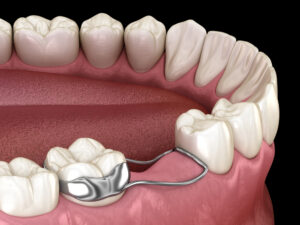 What Is a Space Maintainer?
A space maintainer is a dental appliance, typically made of metal or acrylic, that holds open the gap left by a missing primary (baby) tooth. It is placed in the mouth and gently prevents the neighboring teeth from drifting into the space.
The goal is straightforward: preserve the room the incoming permanent tooth will need. Without that space, permanent teeth may come in crooked, crowded, or impacted, which often leads to orthodontic treatment down the road. A space maintainer is a small intervention that can prevent a much larger problem later.
Why Baby Teeth Matter More Than You Might Think
 It is easy to assume that because baby teeth fall out anyway, losing them a little early is no big deal. In reality, timing matters a great deal. Baby teeth serve as natural placeholders, and the surrounding teeth begin to shift almost immediately when one is missing. Even a few months of unmanaged space loss can affect how permanent teeth develop and erupt.
Beyond spacing, early tooth loss can also affect speech development and your child’s ability to chew comfortably. Addressing the gap promptly is the most straightforward way to protect your child’s long-term oral health.
Types of Space Maintainers
There are several types of space maintainers, and the right choice depends on which tooth was lost, your child’s age, and how much space needs to be maintained.
Fixed Space Maintainers
Fixed space maintainers are cemented in place and cannot be removed by your child. They are the most commonly used type because they require no cooperation from the child to be effective. Common designs include:
- Band and Loop: A metal band is placed around the tooth next to the gap, with a wire loop extending to hold the space. This is one of the most frequently used designs for a single missing tooth.
- Distal Shoe: Used when a primary molar is lost before the first permanent molar has erupted, this appliance extends slightly below the gumline to guide the incoming tooth. It requires careful monitoring and regular follow-up visits.
- Lingual Holding Arch: Used on the lower jaw when multiple teeth have been lost, this appliance connects both sides of the arch to maintain space on both sides simultaneously.
- Transpalatal Arch (TPA): Similar to the lingual holding arch but positioned on the upper jaw, this appliance maintains the width of the upper arch when back teeth have been lost.
Removable Space Maintainers
Removable space maintainers look similar to retainers and may include an artificial tooth to fill the visible gap. They are used for older children who are responsible enough to wear and care for the appliance consistently. Removable maintainers are most appropriate when the missing tooth is in a location visible when smiling, and the child is close to the age when the permanent tooth would naturally arrive.
How We Determine Whether Your Child Needs a Space Maintainer
Not every case of early tooth loss requires a space maintainer. The decision depends on several factors.
- Tooth Location: Front teeth (incisors) are less likely to require a maintainer because surrounding teeth rarely drift significantly into that space. Back teeth (molars) are different. The permanent teeth waiting behind them can shift forward quickly.
- Age and Dental Development: If the permanent tooth is close to erupting, a maintainer may not be needed. If several years of development remain, protecting that space becomes far more important.
- X-rays: We use dental X-rays to assess where the permanent tooth is in its development and how much jaw space is available.
Our dentists will walk you through what the X-rays show and explain the recommendation clearly before any decision is made.
What to Expect When Getting a Space Maintainer
 The process is straightforward. At the initial appointment, we take measurements and, if a custom appliance is needed, an impression of your child’s teeth. In many cases, the maintainer can be placed at the same visit. For fixed appliances, we cement the device into position. The appointment typically takes less than an hour.
Your child may notice the appliance for a day or two as they adjust to how it feels. Most children adapt quickly and go back to speaking, eating, and playing normally without any trouble.
Caring for a Space Maintainer
Proper maintenance helps the appliance stay in place and work effectively. Share these guidelines with your child:
- Avoid sticky and chewy foods like caramel, taffy, and gummy candies, which can loosen or dislodge a fixed maintainer
- Do not push or poke the appliance with fingers or the tongue
- Brush carefully around the bands and wires during regular brushing
- Attend all scheduled follow-up visits so we can check the appliance and monitor the incoming permanent tooth
If the maintainer feels loose, shifts position, or causes persistent discomfort, call our office right away. These situations are usually easy to resolve quickly.
Space Maintainer Costs
Space maintainers typically cost between $150 and $500 per appliance, with the price depending on whether it’s a fixed or removable design and whether one or both sides of the mouth need treatment. Unilateral (one-sided) fixed space maintainers tend to fall on the lower end of that range, while bilateral appliances that span both sides of the arch cost more due to the additional materials and chair time involved.
Many dental insurance plans, including Medicaid in some states, cover space maintainers for children since they play a preventive role in guiding proper tooth eruption after early tooth loss. Without insurance, parents should also budget for follow-up visits to monitor the appliance and, in some cases, an additional fee for removal once the permanent tooth is ready to erupt.